How to Take Care of the Mind
when facing any problem

Drawn from the meditation teachings of Luang Por Dhammajayo, in the Dhammakaya tradition of Luang Pu Sodh of Wat Paknam.
Source teachers: หลวงพ่อธัมมชโย (Luang Por Dhammajayo) · หลวงปู่วัดปากน้ำ (Luang Pu Sodh Candasaro) · คุณยายอาจารย์ (Khun Yay Achan)
All Thai source quotes are taken directly from named YouTube teachings, with the speaker's minute marker noted.
When a problem arises, do not start by fighting the problem. Start by stopping the mind. A still, clear mind is the only ground from which a real solution can grow.

Begin with stillness, not with the problem
No matter what problem appears, the first move is the same: stop the mind. Try to solve a problem from a moving, agitated mind, and you will only multiply the problem.
The single most repeated principle across all the source teachings is the formula หยุดเป็นตัวสำเร็จ — stopping is what completes. This is not advice to do nothing about the problem. It is a sequence: stop the mind first, then act. The mind in motion produces noise; the mind at rest produces wisdom (ปัญญา). Wisdom is what actually solves the problem.
"แม้ปัญหาอะไรจะเกิดขึ้นก็ตาม ก็จะต้องเริ่มต้นจากหยุดกันนิ่งก่อน… ต้องทำใจหยุดนิ่งซะก่อน เพื่อให้ใจจะได้กลับไปสู่แหล่งของสติ ของปัญญา"
No matter what problem arises, you must begin from stopping and stillness first… You must make the mind still, so the mind can return to the source of mindfulness and wisdom.
"เวลาใจหยุดนั่นมันเป็นสมาธิ สมาธิเป็นบ่อเกิดแห่งปัญญา ก็จะเห็นเลยว่าปัญหามันก็มีวิธีการคลี่คลายของมันไป"
When the mind stops, that is concentration. Concentration is the wellspring of wisdom — and you will see that every problem has its own way of unfolding toward a solution.
"โดยเราจะเริ่มต้นแก้ปัญหาในจุดที่แก้ได้ก่อน จากจุดเล็ก ๆ คือ จิตใจเราไปก่อน ทำใจให้มันปลอดโปร่ง ให้มันสบาย ให้มันตั้งมั่น และเดี๋ยวมันก็จะค่อย ๆ คลี่คลายแก้ไขปัญหาไปตามขั้นตอนของมัน"
Begin solving the problem where it can be solved — at the small point, the mind. Make the mind unburdened, comfortable, settled. Then the problem will gradually resolve itself, step by step.
"พอหยุดแล้วเนี่ย ใจมันก็ดับ พอดับดวงธรรมก็เกิด… ถ้าไม่หยุดก็ไม่ดับ ถ้าไม่ดับก็ไม่เกิด"
When you stop, the mind extinguishes [its restlessness]; when it extinguishes, the sphere of Dhamma arises. Without stopping, no extinguishing — without extinguishing, nothing new can arise.
This is the inner mechanic of every teaching that follows. Stop → settle → wisdom arises → action follows. The temptation in a crisis is to skip the first three steps and go straight to action. That is exactly why most decisions made under pressure go wrong.
Bring the mind home — to the center
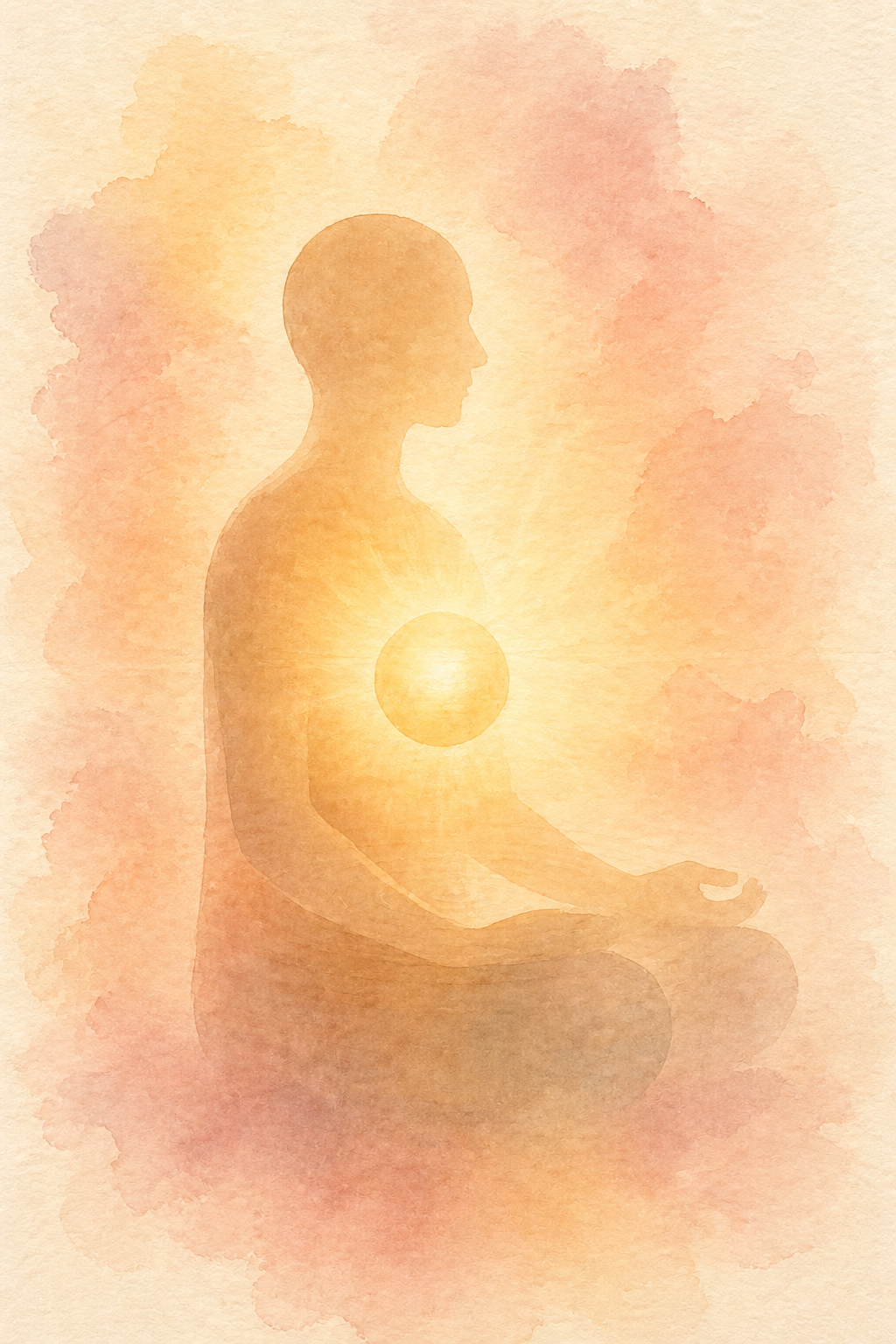
Stillness is not abstract. It has a location. The teachings point to a specific point inside the body — two finger-widths above the navel, the seventh base — as the natural home of the mind.
When the mind drifts out to sights, sounds, opinions, news, and worry, it leaves its home base. That is what suffering is: the mind operating away from its center. The remedy is not philosophical — it is positional. Bring the mind back to the center of the body, and the rest of the system rebalances around it.
The "bed metaphor" given in the teachings makes this physical: if you sleep on the edge of the bed, you are precarious — one wrong turn and you fall. If you sleep in the middle, you are safe and can rest. Living from the edge of yourself is the same kind of precariousness; living from the center is the same kind of safety.
"เอาใจมาตั้งไว้ที่ศูนย์กลางกาย เนี่ยเหมือนเราอยู่ตรงกลางแห่งความมั่นคง… อยู่ริมๆ มันหมิ่นนะ"
Place the mind at the center of the body — this is like resting in the middle of stability itself. Living at the edges, you are precarious.
"ในทางปฏิบัติจริงๆ อย่ามัวค้นหา เสียเวลาทำให้จิตหยาบ ศกก ๗ กลางท้องเหนือสะดือขึ้นมา ๒ นิ้วมือ จำแค่นี้พอ"
In real practice, don't waste time searching — that only coarsens the mind. The seventh base: middle of the abdomen, two finger-widths above the navel. That is enough to remember.
"ตำแหน่งดั้งเดิมของใจ คือ ศูนย์กลางกายฐานที่ ๗ ซึ่งเป็น ‘ตำแหน่งแห่งความสุขและความรู้แจ้ง’ หากใจหลุดออกจากตำแหน่งนี้ไปยึดติดกับ รูป เสียง กลิ่น รส สัมผัส ธรรมารมณ์ หรือสิ่งภายนอก ชีวิตจะมีแต่ความทุกข์ทรมาน"
The mind's original position is the seventh base — the position of happiness and inner knowing. Whenever the mind escapes that position to cling to sights, sounds, smells, tastes, touch, mental objects, or anything external — life becomes nothing but suffering.
The practical instruction during a problem is simple: before responding, place attention gently at the seventh base for one breath. One breath is enough to begin re-centering. Don't strain or visualize precisely — just rest the attention there, comfortably, without forcing.

Keep the mind clear — clarity solves everything
A still mind that is also clear — bright, transparent, unclouded — has solving power that no amount of strategy can replace.
The teachings draw a sharp distinction between two qualities of mind: "sai" (ใส, clear/bright) and "mong" (หมอง, dim/clouded). Almost everything that goes wrong, internally, is some version of letting the mind become "mong" — clouded by grievance, anxiety, gossip, doom-scrolling, fault-finding. Almost everything that goes right is some version of restoring the mind to "sai."
This is the most operationally useful frame in the whole teaching set. Throughout the day, you do not need to ask "is this thought right or wrong?" — you only need to ask "is this making my mind clearer or cloudier?" If cloudier, drop it. That single binary, applied consistently, is the practice.
"ใจใสๆ จะแก้ไขอะไรได้ทุกอย่าง"
A clear, bright mind can solve anything.
"สิ่งที่ผ่านสื่อ ที่ผ่านตา ผ่านหู ล้วนเกี่ยวกับความหมองและใสของใจ… ใจใสก็ไปดี แต่ใจหมองก็ไปไม่ดี… แค่ ๒ คำ หมองกับใสเนี่ย ถ้าใครจำได้ก็เอาตัวรอดนะจ๊ะ"
Everything that comes through the eyes and ears — through any media — is connected to whether the mind becomes clouded or clear. A clear mind goes well; a clouded one goes badly. Just two words: mong and sai. Whoever remembers them will save themselves.
"ใจจะใสได้ มันอยู่ที่เรานั่นแหละจะเลือกบริโภคสิ่งใด… ตา หู จมูก ลิ้น กาย ใจ นี่ต้องเลือกบริโภคนะ"
Whether the mind becomes clear depends on what we choose to consume. The eyes, ears, nose, tongue, body, and mind — all six gates — must be chosen carefully.
"ใจนี่แปลกนะ เป็นธาตุสำเร็จจริงๆ ถ้าเราอยากให้กลุ้ม จงนึกเรื่องกลุ้ม เดี๋ยวสมหวังเลย สมปรารถนาได้กลุ้ม… ถ้าอยากให้ใจใสๆ ให้นึกถึงสิ่งใสๆ"
The mind is strange — it is truly an "element of completion." If you want to be troubled, just think of troubling things, and you will perfectly succeed in being troubled. If you want a clear mind, think of clear things.

When troubled, recall good — don't sit with the worry
When the mind is dragged into worry, do not try to "think your way out." Replace the input. Recall, repeatedly, the good you have actually done.
The reasoning is mechanical. The mind manifests whatever you keep feeding it. Worry repeated ten times produces ten doses of suffering. The remedy is not to suppress the worry — it is to repeat a different input: the recollection of past good actions, kindness given, principles kept. Each recollection produces a small flash of piti (joy, ปีติ), and these flashes accumulate into a clear, bright baseline.
This sounds soft, but the language in the teachings is structural: thinking of merit "denies sin a place to enter." That is, while the mind is occupied with what is good, there is no opening for what is corrosive. Occupy the space; don't leave it for worry to fill.
"ยามมีทุกข์ ก็อย่าไปเสียเวลาไปกลุ้ม ให้นึกถึงบุญที่เราได้สร้างเอาไว้บ่อย ๆ ซ้ำแล้วซ้ำอีกให้ได้ตลอดเวลา บุญก็จะสร้างความใส ขจัดความหมองของใจออกไป ใจก็จะได้ใส ๆ ความใสนี่แหละจะสร้างความสุข"
When suffering arises, do not waste time being troubled. Recall the merit you have made, again and again, continuously. Merit creates clarity, removes the cloudiness of the mind, and the mind becomes clear. That clarity itself is what creates happiness.
"ถ้ากลุ้ม ๑๐ ที เราก็จะได้รับความกลุ้ม ๑๐ ที… เหมือนเรากลุ้มได้หลายที เราก็ต้องนึกปลื้มหลายที"
If you worry ten times, you receive ten doses of worry. So if you can worry many times, you can also recall joy many times.
"การนึกถึงบุญบ่อย ๆ จะทำให้บาปไม่ได้ช่อง"
Recalling merit often denies negativity any opening to enter.

Live from fulfillment — not from waiting for it
Most suffering comes from a posture of waiting: when the problem is solved, when the situation changes, when the answer arrives — then I will be okay. The teachings invert this completely.
The phrase "อยู่ด้วยความสมหวัง ไม่ใช่คอยความหวัง" — live in fulfillment, do not wait for hope — is one of the most operationally radical lines in the source material. It means: do not place your wellbeing on the far side of an outcome. Place it now, in the still and clear mind that is always available, regardless of how the situation looks externally.
When you live this way, situations no longer have power over you. The world will be whatever it is — that is not in your control — but the mind, kept still and clear, stays above the situation rather than thrashing inside it.
"ทำใจให้ใส ๆ ให้หยุดนิ่ง… อยู่ด้วยความสมหวัง ไม่ได้คอยความหวังในใจว่าสมหวังแล้ว ความจริงก็เป็นอย่างนั้นเลย"
Make the mind clear and still. Live in fulfillment — do not stand around waiting for hope. Hold the heart in the state of "already arrived." And in truth, that is exactly how it is.
"สถานการณ์ของโลกหรือสิ่งแวดล้อมจะเป็นอย่างไรก็ตาม แต่ถ้าใจเรานิ่งเฉย ๆ มันจะเข้าถึงความสุขภายในตัว… เราสามารถอยู่เหนือสถานการณ์ได้ เมื่อใจเราไปเชื่อมกับความสุขภายใน"
Whatever the world's situation, whatever the environment — if our mind is simply still, it will reach the happiness inside. We can rise above any situation when the mind is connected to inner happiness.
"ดวงตะวันภายนอกสว่างแค่ครึ่งวัน แต่ดวงตะวันภายในจะสว่างทั้งกลางวันทั้งคืน เมื่อใจเราหยุดนิ่งอยู่ภายใน… ชีวิตเราก็จะไม่พบความมืดเลย ไม่ว่าจะเจอสถานการณ์ใด ๆ ก็ตาม"
The outer sun shines only half a day. But the inner sun shines through both day and night, when the mind rests still within. Then life never meets darkness — no matter what situation arises.

Outside, do your best. Inside, stay still and well-meaning.
Stillness is not withdrawal from life. It is the foundation that makes engaged action possible. The teachings consistently pair the two as one motion.
The instruction is precise: "outside, moving — inside, still" (ข้างนอกเคลื่อนไหว ข้างในหยุดนิ่ง). Outside, do the work, fix the problem, raise the family, run the business, serve the people — and do all of it as well as you possibly can, "better than the best." Inside, do not be hooked by the result, do not strain, do not compete, do not begrudge. Hold one mood, the bright one (อารมณ์ดี อารมณ์เดียว — one mood, the good mood).
This is also where the teachings ask for goodwill — not as a sentiment, but as a stance. Loving-kindness toward all beings, including the people we are in conflict with, including ourselves — is presented as a structural feature of a stable mind. Without it, the inside cannot stay still for long.
"ข้างนอกเคลื่อนไหว ข้างในหยุดนิ่ง / ปล่อยวางทางใจ แต่ไม่ละเลยหน้าที่ / คิดดี พูดดี ทำดี / อารมณ์ดี อารมณ์เดียว / งานก็ทำไป ปัญหาก็แก้ไป บุญก็ทำไป สมาธิก็ทำไป ทำไปพร้อมๆ กัน อย่ารอให้พร้อม เพราะความพร้อมนั้นหาได้ยาก"
Outside, in motion. Inside, still. Let go in the mind, but never neglect your duties. Think well, speak well, act well. One mood — the good mood. Work, solve problems, do good, meditate — all at once. Don't wait until conditions are perfect; perfection is rare in this world.
"เมื่อใจเราจับดี สิ่งดีๆ ก็ติดกลางใจเหมือนกระจกเงา ถ้าเรายิ้มให้กระจกเงา กระจกก็จะยิ้มตอบ ถ้าเราหน้าบึ้งใส่กระจก ก็จะบึ้งตอบเรา"
When the mind catches the good, good things settle at the center of the heart, like a mirror. Smile at the mirror and the mirror smiles back; frown, and it frowns at you.
"ใจขยายเนี่ยก็จะไม่มีวันรู้จักเด็ดขาดถ้าไม่หยุดไม่นิ่ง… มันจะขยายจริงๆ ขยายทั้งใจ ขยายทั้งร่างกายความรู้สึกนะ และความเบิกบาน เหมือนดอกไม้ค่อยๆ ขยายกลีบดอกออกไป"
You will never truly know "an expansive mind" without stopping and stillness. When it expands, it expands fully — mind, body, sensation — and a kind of joy unfolds, like a flower slowly opening its petals.
The five-move sequence
Stop, before responding
One breath, eyes softened. Don't speak, type, or decide. The first instinct in a problem is always to do; resist that for one breath. The breath is not a delay — it's the actual first step of solving.
Bring the mind to center
Rest attention gently in the middle of the abdomen, two finger-widths above the navel. Light, comfortable, no force. Not visualizing precisely — just placing. This relocates the mind from the edge back to the middle.
Recall something good
Bring to mind one specific good action you've taken, or one quality of someone you respect, or one moment of clarity. Not abstractly — specifically. The clarity it produces is what dissolves the cloudiness around the problem.
Drop the demand on the outcome
Adopt the stance of somwang — already arrived. The situation will be whatever it will be. Your wellbeing isn't downstream of the outcome; it's upstream of it. From here, you act — but not from grasping.
Act, with the mind still
Now do the work the problem asks of you — fully, well, without holding back. The decision, the conversation, the action. But the inside stays where you placed it: still, clear, well-meaning. This is the working state.
Seven things to remember
Stop the mind before solving the problem. Stillness is not avoidance — it is the only ground from which a clear answer can grow.
หยุดเป็นตัวสำเร็จ — ไม่หยุดก็ไม่ดับ ถ้าไม่ดับก็ไม่เกิด
Bring the mind to center. Two finger-widths above the navel. Living from the edge of yourself is precarious; living from the center is stable.
นำใจกลับไปสู่ตำแหน่งดั้งเดิม คือ ศูนย์กลางกายฐานที่ ๗
Keep the mind clear, not cloudy. The single most useful question all day is: "is this making my mind clearer or cloudier?" If cloudier — drop it.
ใจใส ๆ จะแก้ไขอะไรได้ทุกอย่าง — แค่ ๒ คำ หมองกับใส
Recall good, repeatedly. The mind manifests whatever you keep feeding it. Worry repeated ten times produces ten doses of suffering — so use the same mechanism in the opposite direction.
ยามมีทุกข์ ให้นึกถึงบุญที่เราได้สร้างเอาไว้บ่อย ๆ
Live from fulfillment, not waiting. Don't postpone your wellbeing until after the situation resolves. The situation will be whatever it is — your stillness is the part you can keep regardless.
อยู่ด้วยความสมหวัง ไม่ได้คอยความหวัง
Outside, fully engaged. Inside, still. Stillness is not withdrawal. Do the work as well as it can be done — and let the inside stay still, clear, and well-meaning while you do.
ข้างนอกเคลื่อนไหว ข้างในหยุดนิ่ง — อารมณ์ดี อารมณ์เดียว
Choose what enters through the six gates. The mind becomes whatever it consumes. Curate inputs — eyes, ears, mind — as carefully as you would curate food.
ตา หู จมูก ลิ้น กาย ใจ — ต้องเลือกบริโภค

"No matter what situation arises, the mind that is still and clear has not lost its peace."
"ไม่ว่าสถานการณ์ชีวิตจะเป็นอย่างไร ใจก็จะไม่สูญเสียความสงบสุข"
— สุขที่เกิดจากใจหยุดนิ่ง · หลวงพ่อธัมมชโย