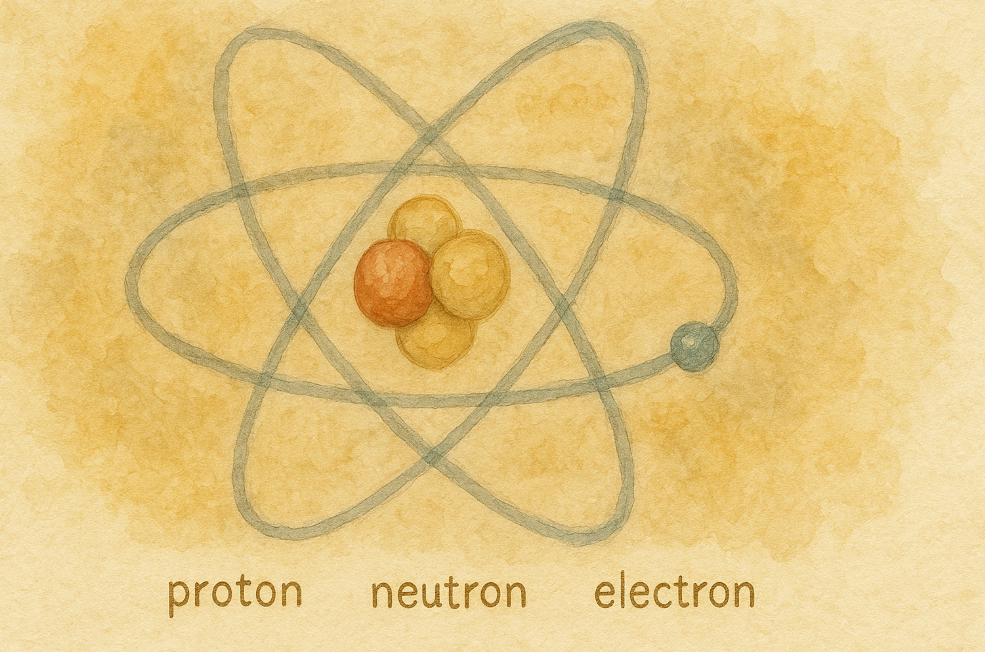
In ancient Buddhist texts, monks calculated the smallest unit of matter. They called it paramāṇu.
Their measurement? Between 9.72 × 10⁻⁹ and 1.33 × 10⁻⁸ centimeters.
Modern atomic measurement? 1.0 × 10⁻⁸ centimeters (1 Angstrom).
Let that sink in. Buddhist monks without microscopes calculated atomic size with stunning accuracy. How?
The Monastic Measurement System
The ancient text Sammohavinodanī lists 14 units of measurement, starting with the paramāṇu. But here's the beautiful part — they defined it using something everyone could access: a grain of rice.
1 paramāṇu = 1/82,301,184 of a rice grain's length
No electron microscopes. No particle accelerators. Just meditation, observation, and rice.
The Rice Grain Experiments
Modern Thai researchers decided to test this. They measured different rice varieties:
- 8mm grains → paramāṇu = 9.72 × 10⁻⁹ cm
- 8.5mm grains → paramāṇu = 1.03 × 10⁻⁸ cm
- 10mm grains → paramāṇu = 1.21 × 10⁻⁸ cm
The magic number? Rice grains around 8.23mm give almost exactly 1 Angstrom.
But how did ancient monks SEE atoms to measure them?
The Meditation Microscope
Buddhist texts describe a systematic process:
- Achieve deep samādhi (concentrated meditation)
- Develop the "divine eye" (dibbacakkhu)
- Progressively refine perception
- Observe matter at subtler levels
- Direct experience of fundamental particles
Not intellectual deduction. Direct perception through consciousness refinement.
It's like tuning a radio to increasingly subtle frequencies until you can detect what was always there but too fine for normal perception.
Other "Impossible" Measurements
The paramāṇu wasn't a lucky guess. Buddhist texts contain multiple precise observations:
Time Dilation
Hell realms where time moves millions of times slower than Earth time. Einstein's relativity says massive gravitational fields create exactly this effect.
Cosmic Distances
Descriptions of "world systems" (galaxies) grouped in clusters of 1,000, million, and billion. Modern astronomy confirms galaxies cluster at these scales.
Biological Precision
Detailed descriptions of embryonic development stages that match modern observations — centuries before microscopes.
The Consciousness Laboratory
Here's the paradigm-shifter: What if consciousness, properly trained, is a measurement instrument?
We accept that instruments extend our senses: telescopes for distant objects, microscopes for tiny objects, X-rays for hidden structures.
Buddhist meditation suggests consciousness itself can be refined into an instrument surpassing any external device.
The Verification Problem
Skeptic: "But you can't verify meditation observations!"
Consider: You can't verify my experience of "red" matches yours. You can't verify Einstein's thought experiments. You can't directly verify quantum mechanics.
Yet we accept these through indirect confirmation. The atomic measurements suggest Buddhist meditation observations deserve similar consideration.
Modern Meditators and Microscopic Vision
Contemporary advanced meditators report similar experiences: seeing cellular processes during deep states, observing energy patterns in matter, direct perception of atomic vibration.
Hallucination? Maybe. But when hallucinations match atomic physics...
Why This Matters Now
For Science
Consciousness might be more fundamental than assumed. Subjective methods might yield objective data. We need new frameworks for inner technologies.
For Human Potential
We've barely tapped consciousness capabilities. Meditation isn't just stress relief. Ancient "superstitions" might be undeveloped sciences.
For Knowledge Integration
Eastern methods + Western verification = New possibilities. Inner exploration + outer measurement = Complete picture. Ancient wisdom + modern tools = Future breakthroughs.
The Challenge to Materialism
The atom measurement suggests consciousness can directly perceive matter's fundamental levels. This flips the standard model:
Materialist view: Matter creates consciousness
Buddhist finding: Consciousness can directly examine matter
What if both are true? What if consciousness and matter are more intimately connected than either tradition alone suggests?
The Rice Grain Revolution
Next time you see rice, remember: ancient monks used these grains to calculate atomic dimensions. Not through equations but through direct perception refined by millennia of meditation technology.
They left us the measurement. And the method.
The measurement proved accurate. What about the method?
Only one way to find out.