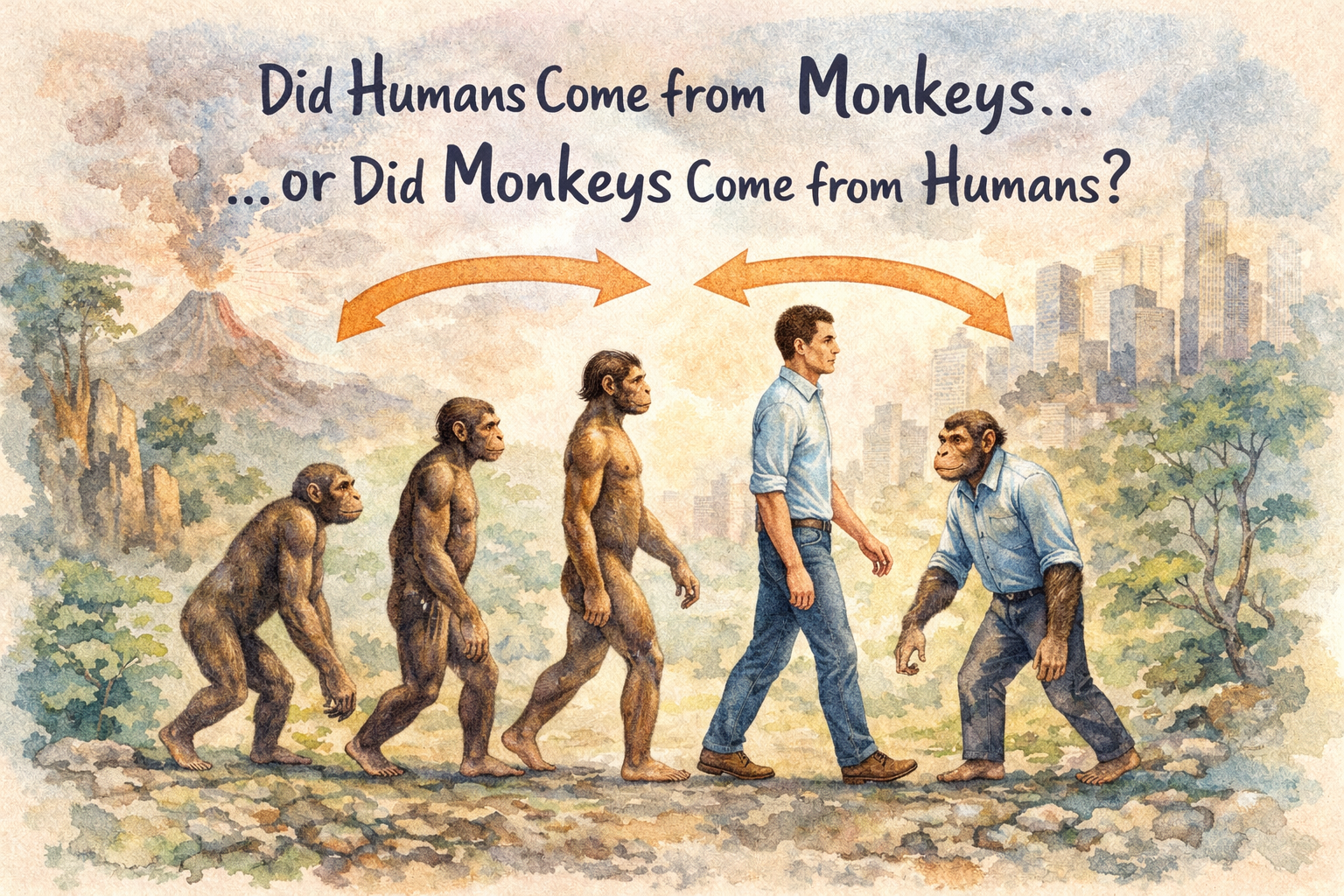
Charles Darwin said humans evolved from apes. The Buddha said the opposite — animals devolved from humans.
Before you pick a side in this cosmic debate, consider that both might be documenting the same process from different vantage points. One looking at bodies, the other at consciousness. One tracking biology, the other tracking morality.
What if evolution and devolution are happening simultaneously?
The Buddhist Bombshell
According to Buddhist cosmology, the first beings on Earth weren't primordial soup — they were radiant beings from higher realms who gradually solidified into human form. Then, as moral degeneration increased, some humans fell further into animal births.
The texts are explicit: animals are former humans who lost their humanity through their actions.
This isn't about growing tails or sprouting fur overnight. It's about consciousness degrading to the point where, at death, it can only support a lower form of life.
The Genetic Plot Twist
Here's where modern science gets interesting. When scientists decoded the genome, they expected huge differences between humans and animals. Instead:
- Humans and chimps share 95-98% of DNA
- Humans and mice share about 90%
- Humans and cats share about 90%
- Even humans and bananas share 60%
The researchers were shocked. Why do we share so much genetic material with creatures that look nothing like us?
Traditional evolution says: common ancestor. Buddhist texts say: common origin, different trajectories.
The Devolution Mechanism
Buddhism describes a precise process:
- Human with full morality → maintains human birth
- Human breaking moral principles → consciousness degrades
- Continued moral violations → consciousness can't sustain human form
- Death and rebirth → consciousness takes animal form
- Animal existence → working off negative karma
- Eventual return → possibility of human birth again
It's not Darwinian natural selection — it's karmic selection.
Modern Evidence That Makes Scientists Squirm
The Consciousness Problem
Why do humans have self-awareness far exceeding survival needs? Moral sense that often conflicts with survival? Spiritual yearning that serves no evolutionary purpose? Willingness to die for abstract principles?
If we evolved purely through survival pressures, these traits are problematic. But if consciousness came first and degraded into survival mode? Different story.
The Domestication Mystery
Scientists can't fully explain self-domestication — wolves becoming dogs, wild cats becoming house cats, multiple animals independently seeking human partnership.
Buddhist view: These animals retained karmic connections to humanity. They're not random species — they're beings working their way back.
The Intelligence Anomalies
Some animals display human-like traits: elephants conducting "funerals," dolphins saving humans, dogs showing guilt and shame, primates using sign language to express emotions.
Vestiges of previous humanity? Or convergent evolution? The Buddhist texts suggest the former.
The Two-Way Street
Here's the mind-bender: Buddhism doesn't deny physical evolution. Bodies adapt, change, evolve. But consciousness follows different rules:
- Physical Evolution: Simple → Complex
- Consciousness Devolution: Pure → Degraded
They're both happening: bodies becoming more sophisticated, consciousness becoming more entangled, technology advancing, wisdom declining. We're evolving machines while devolving as beings.
The Practical Implications
For How We See Animals
Not "lesser beings" but "temporarily disadvantaged beings." Deserving compassion, not just conservation. Potentially your former relatives (literally). Working through their own karmic processes.
For How We Live
Every moral choice affects your future form. Human birth is precious and precarious. Kindness to animals helps them progress. Our actions determine our trajectory.
The Integration Challenge
What if both Darwin and Buddha were right? Bodies evolved from simple forms. Consciousness devolved from luminous states. We're biological animals with transcendent potential. We're spiritual beings having a material experience.
The full story might require both telescopes — one pointed at matter, one at mind.
Next time you see an animal, consider: fellow traveler on the journey of consciousness. Different chapter, same story. And remember — your next chapter depends on how you write this one.
Choose wisely. Your future form depends on it.