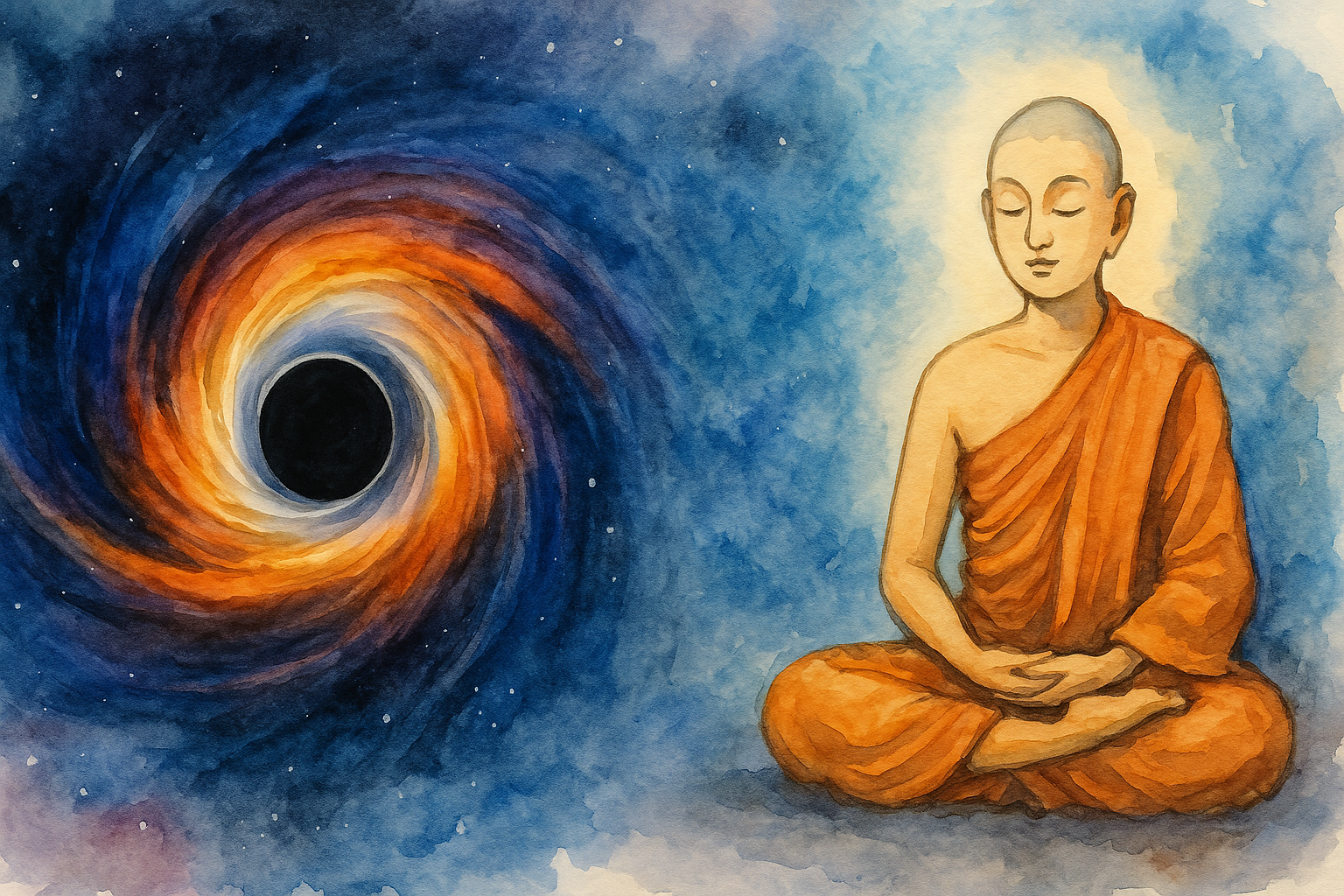
Black holes fascinate us.
They're powerful, invisible, and can bend time and space. In Western science, black holes are described as collapsed stars with gravity so strong that not even light can escape.
But Buddhism has something to say about that too. Not in technical terms — but in terms of how we relate to the unknown.
Let's explore how black holes mirror the Buddha's teachings — and how both East and West invite us to look deeper.
What Science Says About Black Holes
In Western astrophysics:
- A black hole forms when a massive star collapses.
- Its gravity pulls in everything nearby — including light.
- Inside the black hole is the singularity, where physics as we know it breaks down.
- The boundary is called the event horizon — beyond it, no information comes back.
In short: it's the ultimate unknown.
What the Buddha Taught About the "Unknowable"
Buddhism teaches that there are certain things we cannot grasp by intellect alone. These are called acinteyya — the imponderables.
The Buddha said: trying to figure this out with thinking alone will wear you out. But not because they're useless. Because they require a different kind of seeing — insight, stillness, inner clarity.
Black Hole ≈ Karma Hole?
Here's a mind-stretching analogy:
| Black Hole (Science) | Karma (Buddhism) |
|---|---|
| Pulls everything into itself | All actions have consequences — even unseen ones |
| Has an event horizon — no return | There's a line where habits become hard to reverse |
| We can't observe it directly | Karma unfolds silently — until results show up |
| Singularity defies logic | Karma links cause-effect across lives, beyond logic |
| Still being studied | Still being realized through meditation |
In both views, what's "invisible" still shapes the visible. What's unseen doesn't mean it's unreal.
So What Do We Do With the Unknown?
Western science looks at the unknown with curiosity and equations. Buddhism looks at the unknown with awareness and stillness.
But both agree on this: The more we observe without ego, the more we understand.
You don't need to solve every mystery. But you can live with wonder, presence, and humility — whether staring into a telescope or sitting in meditation.
Final Thought
The universe is vast. So is your mind.
Black holes remind us that not everything can be controlled or calculated — but everything can be approached with reverence.
The Buddha didn't need a spaceship. He mapped the universe from the inside out. And maybe that's the real frontier.