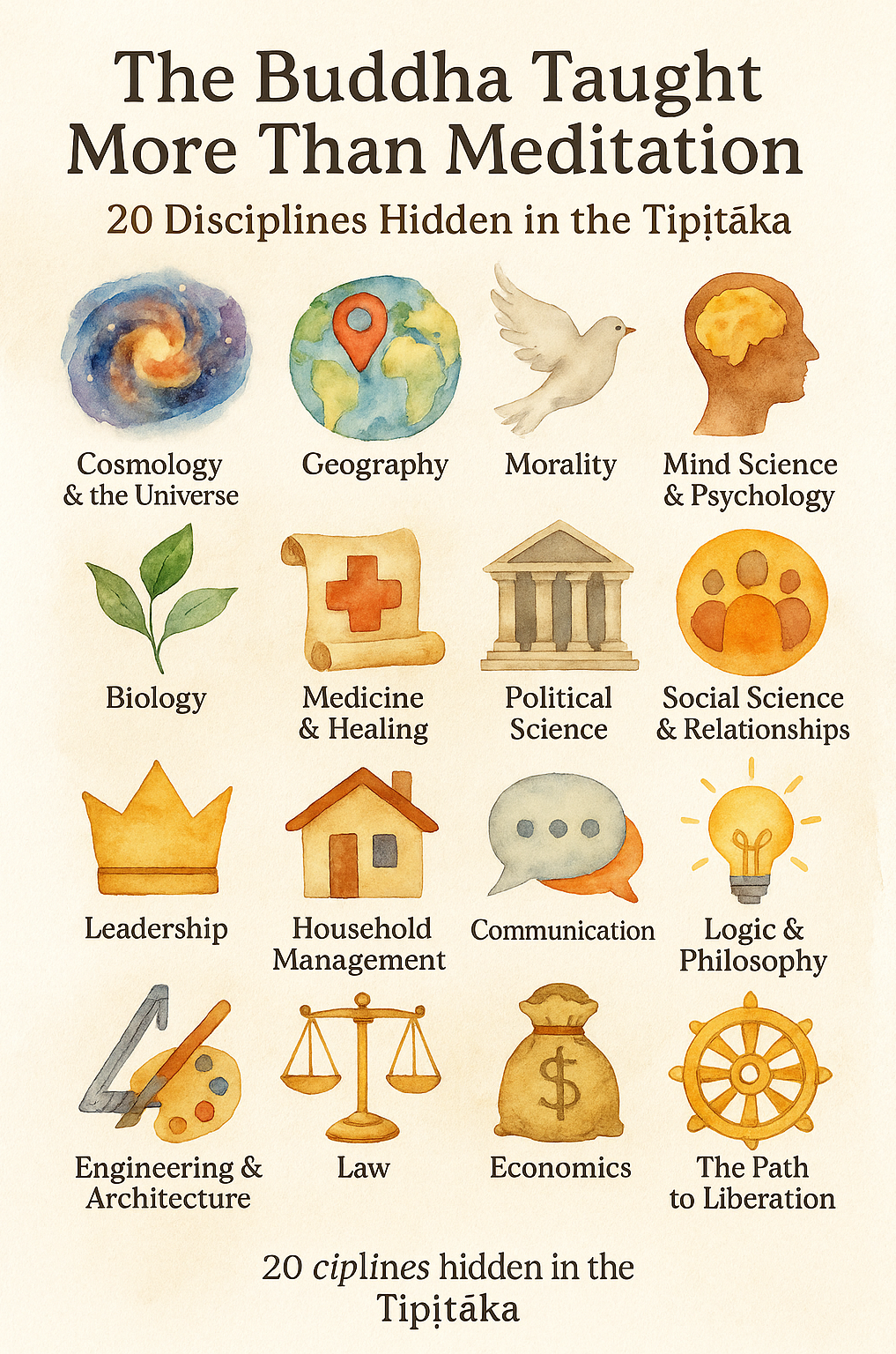
When we think of the Buddha, most people imagine mindfulness, monks, or perhaps the Four Noble Truths. But if you look deeper into the Tipiṭaka — the Buddhist scriptures — you'll find something surprising.
The Buddha didn't just teach how to end suffering. He taught about how life works — across 20 different disciplines, from the cosmic to the microscopic.
Let's take a tour through this ancient wisdom library — one that might just rival a modern university.
1. Cosmology & the Universe
The Buddha spoke of world systems that arise, evolve, and dissolve — a cycle not unlike what astrophysicists now explore. He didn't just explain "what's out there," but how we relate to it with humility and mindfulness.
2. Geography
From detailed references to mountains, rivers, and regions, the scriptures reflect a keen observation of terrain and environments — not just as maps, but as influences on human behavior and karma.
3. Morality
Ethics isn't a side topic in Buddhism — it's the backbone. Whether you're a monk, leader, or layperson, there's clear guidance on how to live in harmony with self and others.
4. Mind Science & Psychology
Centuries before Freud, the Buddha mapped the mind. He taught how thoughts arise, how craving forms, and how to quiet the mental chatter.
5. Biology
There are insights into how beings are born, age, and die — including discussions on bodily functions and elements (earth, water, fire, air) long before microscopes.
6. Medicine & Healing
Beyond prescriptions, the Buddha taught that mental purification supports physical healing. Clean water, fresh air, balance in food — all were part of his advice to monks and laypeople alike.
7. Political Science
The Buddha gave rulers direct advice: rule with fairness, protect the vulnerable, and avoid greed. He supported consultation and collective decision-making — what we'd now call early democratic values.
8. Social Science & Relationships
Whether it was family, workplace, or community, the Buddha emphasized respect, generosity, and emotional intelligence. Harmony starts at home — and spreads outward.
9. Leadership
Qualities of a great leader? The Buddha laid them out in frameworks like the Ten Royal Virtues and the Seven Noble Qualities — all still relevant today.
10. Household Management
Buddhism isn't just for renunciants. The Buddha taught laypeople how to manage money wisely, raise ethical children, and run households with balance and love.
11. Communication
Speech can heal or harm. The Buddha taught "Right Speech" — truthfulness, gentleness, and timing — long before communication theory was formalized.
12. Strategic Thinking
Call it wisdom in action. The Buddha used timely questions, analogies, and silence when needed. His strategic guidance helped individuals shift without shame.
13. Education
To the Buddha, education wasn't about degrees. It was about cultivating sīla (ethics), samādhi (concentration), and paññā (wisdom) — a full system for personal mastery.
14. Law
Rules weren't just for monks. The Buddha addressed justice, consequences, and fairness in society — helping establish order without oppression.
15. Economics
The Buddha didn't reject wealth — he just taught it should be earned ethically, spent wisely, and shared generously.
16. Logic & Philosophy
Rather than debate for debate's sake, the Buddha used logic to cut through confusion and get to the heart of truth. "Come and see," he said — not "Come and believe."
17. Engineering & Architecture
While not a civil engineer, the Buddha supported well-built monasteries, sustainable living, and intelligent layout of communal spaces.
18. Aesthetics & Fine Arts
Buddhist art and storytelling were used to uplift minds. Even silence and presence were treated as forms of art — where the message was in the experience.
19. Life Guidance
Career? Vocation? Purpose? The Buddha gave practical advice on how to live with integrity — not just in monasteries, but in markets and fields.
20. The Path to Liberation
And of course, the ultimate science — how to end suffering. The Abhidhamma is a deep exploration of mental states, causality, and transcendence.
Final Thought: A 2,500-Year-Old Liberal Arts Curriculum?
It's tempting to think of Buddhism as just spiritual. But it's more like a full life operating system — one that includes body, mind, society, and the cosmos.
The Buddha didn't create division between disciplines. He integrated them — with wisdom, ethics, and clarity at the center.
So whether you're a leader, teacher, parent, or seeker, this timeless library has something for you.