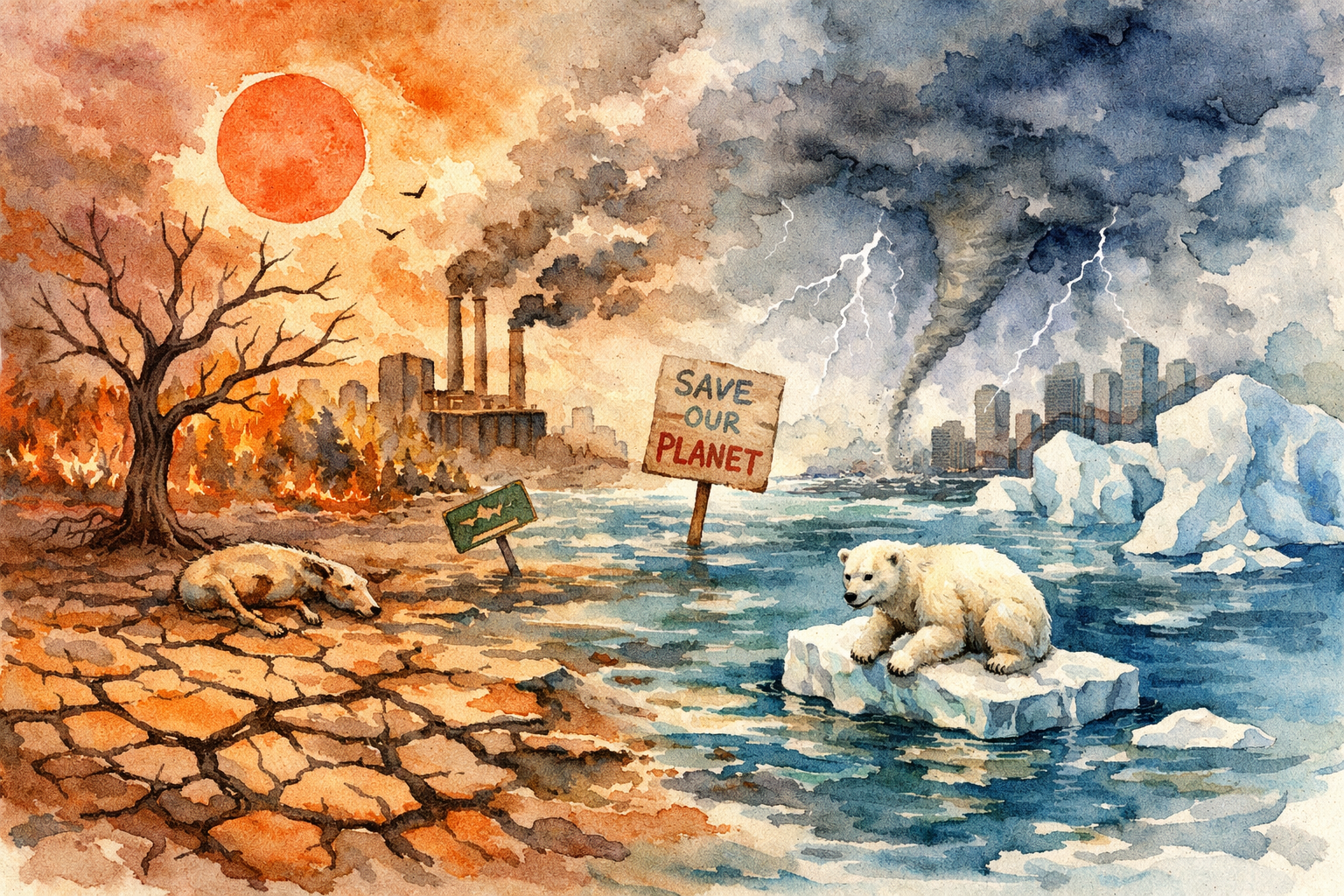
Twenty-five hundred years ago, the Buddha described something that would make modern climate scientists do a double-take: human morality directly affects weather patterns, natural disasters, and crop yields.
Before you dismiss this as ancient superstition, consider that we now know human behavior indeed changes the climate — just through different mechanisms than we initially imagined.
The Shocking Ancient Text
In the Dhammika Sutta, the Buddha lays out a precise domino effect: When rulers live unrighteously, their ministers follow suit. When ministers are unrighteous, priests and householders follow. When the people are unrighteous, the sun and moon go wrong in their courses — winds blow wrong, rains fall out of season, crops ripen poorly, and people who eat poorly ripened crops become short-lived, weak, and sickly.
Replace "unrighteousness" with "carbon emissions" and "gods" with "climate systems," and you've got a modern climate change narrative.
The Fifth Law of Nature
Buddhist cosmology describes five natural laws (niyama) that govern everything:
- Physical laws (utu-niyama): physics, chemistry, weather
- Biological laws (bija-niyama): genetics, living systems
- Psychological laws (citta-niyama): how consciousness works
- Karmic laws (kamma-niyama): moral cause and effect
- Dharma laws (dhamma-niyama): how all the other laws interact
That fifth law is the kicker. It suggests these aren't separate systems but interconnected ones. Human consciousness and behavior can influence physical systems — not through magic, but through complex interconnections we're only beginning to understand.
Modern Science Catches Up
Recent research keeps revealing these unexpected connections:
The Meditation-Plant Studies
Dr. Masaru Emoto's water crystal experiments showed human intentions affecting water structure. Thai scientist Dr. Acharn Chumsai found that plants receiving loving-kindness meditation grew 49.2% taller than control groups.
The Violence-Temperature Connection
Studies now show correlations between rising temperatures and increased violence. The Buddha's text suggested the reverse too: that collective human violence and greed create conditions for environmental disruption.
The Greed-Destruction Cycle
Buddhist texts specifically link different mental poisons to different types of natural disasters:
- Greed → floods (overconsumption/imbalance)
- Hatred → fires and droughts (consuming rage)
- Delusion → storms and earthquakes (chaotic forces)
Metaphorical? Perhaps. But consider how greed-driven overconsumption literally causes flooding through sea-level rise, or how the "heat" of human conflict correlates with actual temperature increases.
The Butterfly Effect, Ancient Style
The Buddhist teaching isn't saying if you get angry, a tornado will hit your house. It's describing something more like chaos theory — how small actions aggregate into large-scale effects through complex systems.
What This Means for Us
1. Climate action is also inner action
Yes, we need solar panels and policy changes. But the Buddhist view adds another dimension: the collective mental state of humanity matters. Greed, hatred, and ignorance aren't just spiritual problems — they're environmental ones.
2. Everything really is connected
Not in a vague "we're all one" way, but through specific, traceable (if complex) relationships. Your morning meditation might not stop a hurricane, but the collective consciousness of billions? That's a force of nature.
3. There's more to measure than carbon
What if environmental health indicators included measurements of societal greed, violence, and delusion? What if we tracked "gross national wisdom" alongside GDP?
The Practical Takeaway
The Buddha wasn't an environmentalist in the modern sense — there were no factories to protest. But he understood something we're rediscovering: human inner states and outer environments mirror each other.
This doesn't mean we should meditate instead of reducing emissions. It means we should do both, understanding them as connected practices. Clean up your mind and clean up the world — they're the same project viewed from different angles.
Your Part in the System
Next time you read about climate change, consider: How does collective human greed drive overconsumption? How does widespread anger and division prevent collaborative solutions? How does ignorance of interconnection enable destructive behaviors?
And more personally: How does your mental state contribute to the collective consciousness? What would change if you treated inner pollution as seriously as outer pollution?
The ancient texts suggest that when humans live in harmony with moral laws, nature responds with abundance. When we don't, we get... well, look around.
Maybe the Buddha's climate science isn't so primitive after all. Maybe we're just catching up to understanding how consciousness and cosmos interact.