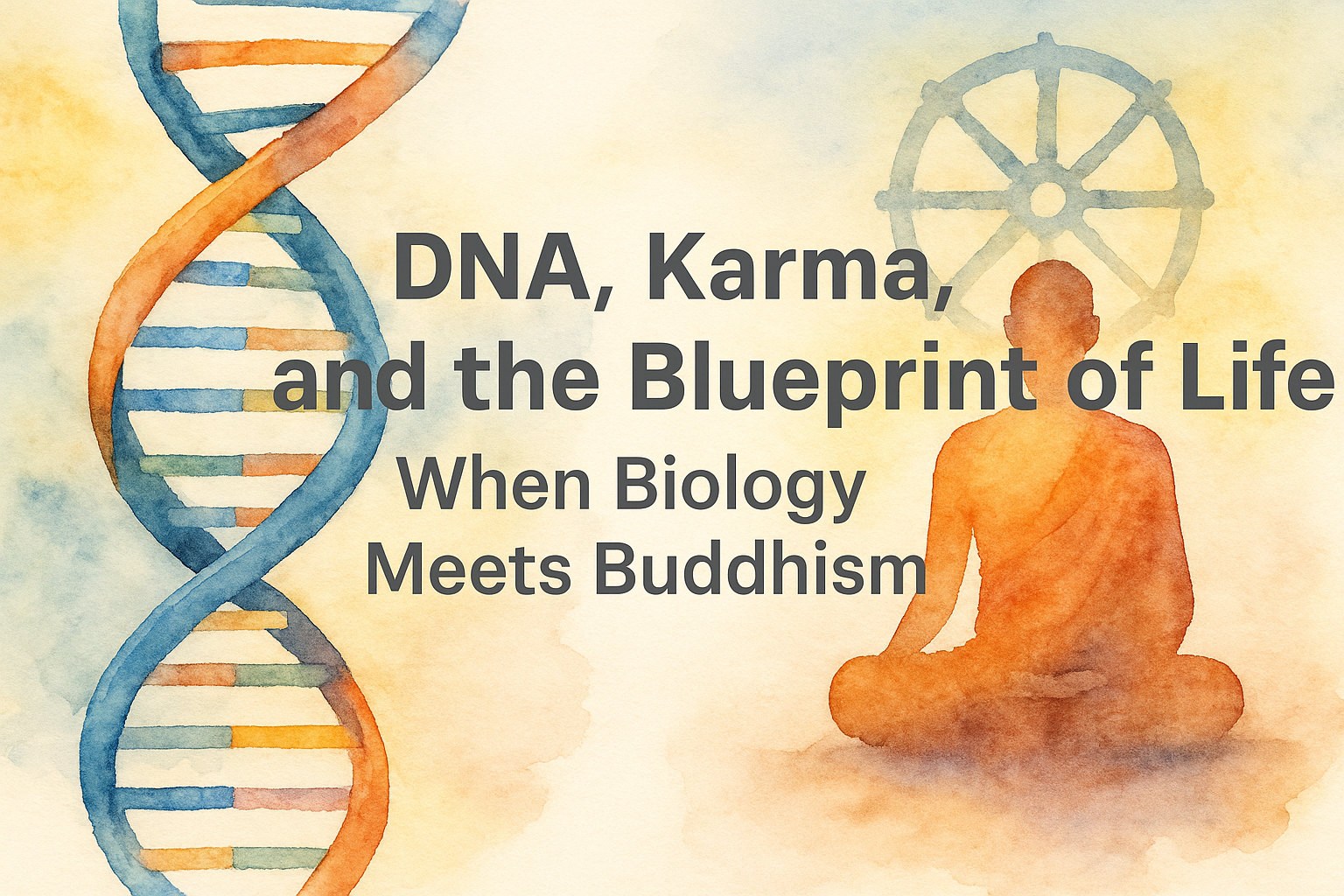
We all know by now that DNA is the instruction manual for life. It tells our cells how to grow, look, and behave. Scientists call this the genome — a massive library written in four chemical letters (A, T, C, G) that shapes every living being on Earth.
But here's something fascinating: The Buddha talked about this — in his own way — over 2,500 years ago.
Not with microscopes or lab coats. But with wisdom about cause and effect, rebirth, and the hidden patterns that shape who we become.
Let's explore how Eastern and Western views of life's blueprint might actually meet in the middle.
The Genome: Nature's Master Script
In modern science, your genome:
- Determines your eye color, height, health risks
- Guides how your body responds to food, sleep, and even stress
- Gets passed down from parents through generations
It's incredibly detailed — like a cosmic recipe book inside every cell. But here's where it gets interesting...
Karma: The Invisible Code
In Buddhism, karma isn't just "what goes around comes around." It's a causal force — the result of intentional actions (thoughts, speech, deeds) that carry forward, shaping future experiences and even future lives.
In the same way DNA is passed biologically, karma is passed mentally and ethically. It's not random. It's encoded in the flow of consciousness.
So... What If Karma Is Like DNA?
Think about it this way:
| Biology | Buddhism |
|---|---|
| Genes shape the body | Karma shapes the mind |
| Genomes carry traits | Karma carries tendencies |
| DNA is passed by birth | Karma is passed by rebirth |
| Mutations affect growth | Unwholesome thoughts distort behavior |
| Epigenetics turns genes on/off | Mindfulness turns karma around |
In both views, nothing happens without a cause. And both views say: What you are now is built by what came before.
Rebirth & Recoding
Scientists now know that genes aren't destiny. We can turn genes on or off through lifestyle, food, emotions, and environment — this is called epigenetics.
In Buddhism, the same is true of karma. You're not trapped by your past. Through meditation, mindfulness, and right action, you can rewrite your future.
You can't change the parents you were born to. But you can change the person you're becoming.
Final Thought
The Buddha didn't talk about genes. But he understood the deeper laws of nature: that everything arises from causes, and that those causes can be understood, purified, and transformed.
DNA shows us the patterns of life. Dhamma shows us the freedom beyond those patterns.
And when you put them together? You realize: Life is both science and story — and you're the author of the next chapter.