Every generation of leaders inherits the same unfinished project. We sign treaties, broker ceasefires, hold summits, publish frameworks — and conflict keeps rebooting anyway, in living rooms, boardrooms, and between nations. After enough cycles of this, a reasonable person starts to wonder: what if we've been patching the wrong layer of the system?
That question has a surprisingly precise answer in the Thai Buddhist tradition I grew up in. In 1999, the meditation teacher Luang Por Dhammajayo gave a short talk with a title that sounds almost defiant: world peace is not a fantasy [1]. His argument wasn't sentimental. It was structural: peace on the outside can only be compiled from peace on the inside — and inner peace, unlike geopolitics, is something every single human being can actually reach.
Here's the blueprint, translated for anyone who leads anything — a family, a classroom, a team, a company, a movement.
We Keep Patching the Outputs
There's a reason the United Nations maintains an official International Day of Peace. Established by resolution in 1981 and fixed in 2001 to September 21 as a worldwide day of ceasefire and nonviolence, it exists because humanity's default settings keep producing the opposite. The UN even declared 2001–2010 a decade for building a "culture of peace," naming six aims: respect for all life, rejection of violence, generous sharing, deep listening, care for the planet, and inclusive solidarity [4].
Read that list closely and you'll notice something. All six are downstream behaviors. They describe what a peaceful mind does naturally — and none of them run reliably on a mind flooded with fear, resentment, or craving. Even the architects of the official peace day understood this; the deeper intent behind those six aims was to point people toward the quiet foundation underneath them all: peace inside the individual heart.
Treaties, policies, HR handbooks, codes of conduct — all necessary. But they're patches applied at the output layer. The source code is upstream.
The Original Root-Cause Analysis
Buddhism ran this diagnosis about 2,600 years ago and its findings still hold. Every untrained mind ships with three background processes: greed (the grabbing program), ill will (the attack-and-defend program), and delusion (bad data about how reality works). The tradition calls them kilesa — usually translated "defilements," though for modern readers "malware of the mind" is closer to how they behave. They run quietly, consume enormous resources, and corrupt your outputs.
Luang Por Dhammajayo taught it plainly: as long as human minds are dominated by greed, anger, and delusion, conflict and war remain installed on this planet — dormant at times, but always ready to execute [5]. Which sounds bleak until you hear the other half of the teaching. When a person genuinely touches inner peace, he said, the impulse toward conflict drains away on its own. Genuine goodwill (metta, often translated loving-kindness) arises toward other human beings — and the desire to give starts to outweigh the desire to take [2] [3].
That last line is an entire geopolitical theory in miniature. Peace isn't something a peaceful mind decides to do. It's what a peaceful mind ships by default.
Notice what this diagnosis is not: a guilt trip. If the root cause of conflict lived only in institutions, most of us could do nothing but spectate. Because it lives in the mind, everyone owns a piece of the fix — and the piece you own happens to be the only territory on Earth you fully govern.
Three Teachers, One Transmission
A century ago in Bangkok, a monk revered as Luang Pu Wat Paknam (Phramongkolthepmuni) revived a meditation method built around one deceptively simple move: bringing the mind to complete stillness at the center of the body. He taught that a human being's deepest resources — clarity, purity, a happiness that doesn't depend on conditions — become accessible right there, at that still center [9].
His student, Khun Yay Achan Chandra Khonnokyoong, never learned to read or write. She became one of the most respected meditation masters of her generation anyway — living proof that this knowledge isn't academic [10]. In 1970, already in her sixties, she led a small group of her own students in transforming a rice paddy north of Bangkok into a meditation center that would eventually welcome people from every continent [11].
One of those students, Luang Por Dhammajayo, then spent the following decades doing something unusual with the phrase "world peace through inner peace." He refused to leave it as a slogan. He treated it as an engineering project — with curricula, programs, and participation numbers [5].
The through-line of this lineage is a claim any leader can respect: peace is trainable.
Peace Scales Like Literacy
How do you scale an inner state? The same way you scale reading: teach it early, teach it everywhere, make it ordinary.
Starting in 1982, a Dhamma-study program called the Path of Progress invited Thai students to learn and be tested on a classic Buddhist guide to living well. The first exam drew 382 students. By 2006, annual participation had passed 4.7 million students from nearly 20,000 schools, and the project had earned recognition on international stages, including under UNESCO's culture-of-peace decade [5].
Then came the deliberate next step: the World Peace Ethics Contest, or World-PEC — and its design choice is the part worth studying. In Thailand, entrants didn't sit the exam alone. They registered as teams of three family members, studying the same handbook of life principles together at home. The reasoning: the family is the smallest unit of world society. A warm, harmonious household is the original peace treaty — and if goodwill can be installed at home, it propagates outward on its own, without enforcement [5].
The first international round drew participants from six continents and some sixty nationalities. Buddhists sat alongside Christians, Muslims, Hindus, Jews, and Sikhs. A seven-year-old boy in Germany talked his way into registering alongside his parents. An 89-year-old grandmother in Tennessee studied daily. A blind woman in Minnesota arranged for the questions to be read aloud so she could answer. A Christian university student in Sweden read the English study text and concluded it was simply sound, universal instruction for living [5].
The point isn't the exam. It's the reframe underneath it: peace can be treated as a literacy — teachable, testable, scalable — rather than a mood we hope breaks out on its own. The architecture is a nested rollout: one person, then a household, then a community or organization, then a nation, then a world. No level gets skipped, and every level inherits its stability from the one inside it.
What Stillness Does to Decision-Making
If you lead people, here's the layer you can verify fastest.
Marco Bermudez, a founder from Bogotá, Colombia — business degree, master's in education, runs an online scholarship platform — came to this practice as a skeptic's skeptic. What won him over first wasn't an experience but a policy: the Buddha's discourse to the Kalama people (Kalama Sutta), which instructs students not to accept teachings on authority, tradition, or charisma, but to test them against reason and direct experience. It may be the most engineer-friendly instruction in the history of religion.
After years of daily meditation, his report reads like a performance review of his own mind: thoughts organized themselves, intuition sharpened, and on genuinely complex problems the best answer would surface while the mind was quiet — "as if the information sorted itself out" [7]. Any executive recognizes the pattern from the other direction: your clearest calls have never once arrived mid-adrenaline. Settled, unified attention (samadhi) isn't a luxury for monks. It's the operating condition good judgment was always waiting for.
It works at group scale too. In 2008, an international network of young peace-movement leaders held its annual council in Thailand, and the hosts made one structural choice: a meditation retreat first, then a shared silence before every working session. The council's founder, a veteran American educator named Dr. Nina Meyerhof, reported something she said she'd never seen at their gatherings — no walls between people, a family-like unity, and an agenda that moved faster than planned. She credited the stillness [8]. One participant, Father Terry Gallagher, a Catholic priest from Canada, completed the whole retreat, kept a small medal of Luang Pu Wat Paknam as a keepsake for his daily sitting, and left praying that everyone on Earth would get the same chance to learn [8]. He didn't stop being Catholic. He simply discovered the practice runs on any operating system.
And the cost of deployment? Luang Por Dhammajayo liked to point out that meditation is the rare intervention that is easy, direct, and a shortcut all at once — maximum benefit, zero investment [2]. No license fee. No procurement cycle. The infrastructure is your own attention.
The Deeper Map, Held Lightly
Honesty requires one more layer, so let me mark it clearly.
In this tradition's own language, the stillness at the center of the body eventually opens onto something Luang Pu Wat Paknam called the Dhammakaya — literally, "the body of truth." It is described as an inner refuge: an inexhaustible source of happiness, purity, mindfulness, and insight; the destination every restless search was pointing at all along. Luang Por Dhammajayo's 1999 claim was exactly this strong: if human beings everywhere reached that inner refuge, world peace would follow — not as fantasy, but as consequence [1].
You don't need to adopt the full map to run the experiment. The tradition itself insists you shouldn't take it on faith — that's the Kalama Sutta again. The verifiable layer arrives early: a calmer nervous system, cleaner decisions, more patience and generosity under pressure. The deeper layers are there when, and only when, your own experience makes you curious.
Try This: The One-Minute Ceasefire
Every September 21, the world is invited to observe one minute of silence and stillness for peace [4]. One minute sounds laughably small against war — until you remember whose minute it is: yours, in the one jurisdiction where your authority is absolute. Here is a version you can run today, drawn straight from this lineage's instructions:
- Sit comfortably and close your eyes softly. No effort, no aiming at an experience. One Thai verse describes it as closing the eyes gently, without straining to look for anything at all [7].
- Rest your attention at the center of your body — inside the abdomen, a couple of finger-widths above the navel. Approximate is fine. "The calm center of you" is the real address.
- If thinking is loud, park it on a soft word. The tradition uses Samma Arahang; any neutral, calming word repeated gently will do.
- When the minute ends, notice before you move: what does this state make possible that the previous one didn't?
Leaders, institutionalize it. Sixty shared seconds of quiet before the agenda costs nothing and changes the room. Minds that arrive still don't spend the first twenty minutes positioning, defending, and fearing — which is to say, running the malware.
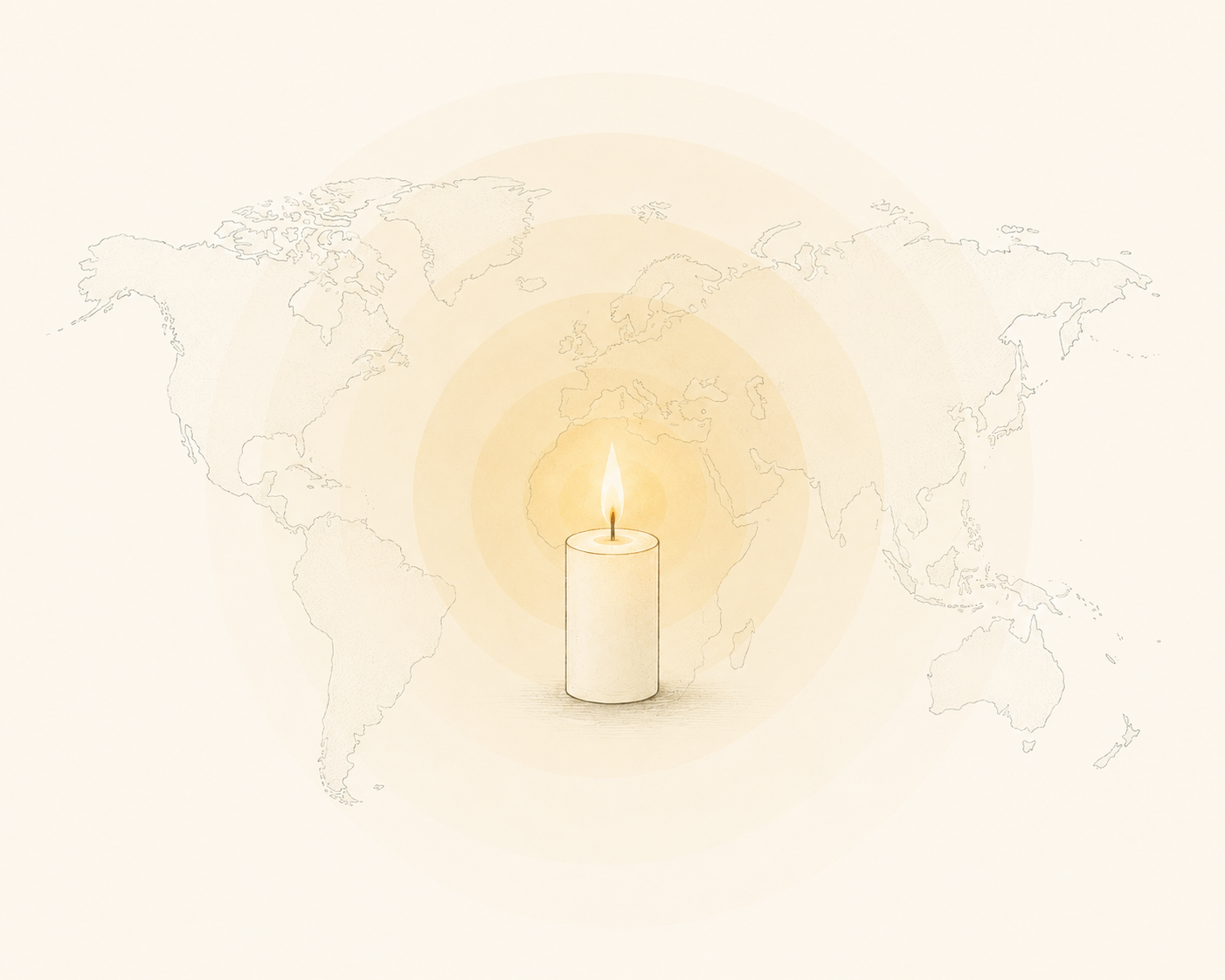
One last term worth keeping: kalyanamitra, "good friend" — a person whose presence makes other people's best qualities easier to access. The tradition offers a beautiful image for it: one such person is a single candle, bright but small in radius. A world with millions of them is simply lit [6]. Leadership, in this frame, is candle math. Your calm is contagious. So is your fear. In every meeting, you are multiplying one or the other.
Where Peace Actually Starts
None of this says world peace is your fault. That's the guilt reading, and it's the wrong one. The accurate reading is far more interesting: world peace has an entry point that is not above your pay grade. Nations will keep negotiating and institutions will keep patching — good. But underneath all of it, every one of us holds admin access to exactly one mind, and history's quietest revolutionaries — a monk in Bangkok, an unlettered woman with unshakable stillness, a teacher who refused to call peace a fantasy — kept insisting that this is where the real build happens.
So here is your reflection question for the week: What would your next difficult conversation be like if you walked in already at peace — nothing to grab, nothing to defend, nothing to fear?
Take the minute. Then go find out.
Sources
All sources are published on kalyanamitra.org, the online Dhamma library of the Dhammakaya community. Thai titles are given with English glosses.
- สันติภาพโลกไม่ใช่เรื่องเพ้อฝัน (World Peace Is Not a Fantasy) — teaching of Luang Por Dhammajayo, 30 May 1999, from Teachings of Khun Khru Mai Yai, Vol. 3.
- สันติภาพโลกเกิดจากสันติสุขภายใน (World Peace Arises from Inner Peace) — teaching of Luang Por Dhammajayo, 6 October 2007, from Teachings of Khun Khru Mai Yai, Vol. 3.
- สันติภาพของโลก เกิดจากสันติสุขภายใน (The World's Peace Arises from Inner Peace) — restatement of the teaching, 15 February 2016.
- วันสันติภาพโลก ตรงกับวันที่ 21 กันยายน ของทุกปี (World Peace Day, September 21) — history of the UN International Day of Peace, its six aims, and the one-minute stillness observance.
- World-PEC สร้างสันติภาพโลก ด้วยสันติสุขในครอบครัว (World-PEC: Building World Peace Through Peace in the Family) — Yoo Nai Boon journal article on Luang Por Dhammajayo's peace work, the Path of Progress program, and the first World Peace Ethics Contest, including the participant stories retold above.
- กัลยาณมิตรกับสันติภาพโลก (The Kalyanamitra and World Peace) — the "one candle" teaching on good friends as the engine of world peace.
- World Peace Through Inner Peace — สันติภาพโลกเริ่มจากสันติสุขภายใน — Yoo Nai Boon journal article containing the meditation verse and the account of Marco Bermudez of Bogotá, Colombia.
- "WSYC" กับการค้นพบครั้งยิ่งใหญ่ "สมาธิ" คือ พลังสร้างสันติภาพโลก (WSYC and the Great Discovery: Meditation as the Power That Builds World Peace) — Yoo Nai Boon journal article on the 2008 World Spirit Youth Council gathering in Thailand, with the accounts of Dr. Nina Meyerhof and Father Terry Gallagher.
- ประวัติย่อ พระมงคลเทพมุนี (สด จนฺทสโร) (Brief Biography of Phramongkolthepmuni — Luang Pu Wat Paknam)
- ประวัติย่อ คุณยายอาจารย์มหารัตนอุบาสิกาจันทร์ ขนนกยูง (Brief Biography of Khun Yay Achan Maharatana Upasika Chandra Khonnokyoong)
- คุณยายอาจารย์มหารัตนอุบาสิกาจันทร์ ขนนกยูง ผู้ให้กำเนิดวัดพระธรรมกาย (Khun Yay Achan: The Founder of Wat Phra Dhammakaya) — the 1970 founding of the temple on a rice field in Pathum Thani.